
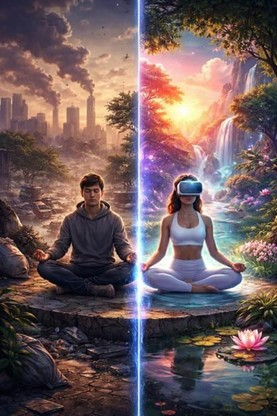
As we advance in technology, this question is no longer just a fictional thought but is increasingly seen as a serious debate. In Reality+, philosopher David Chalmers argues that virtual worlds are neither fake nor any less real than our reality. He says, “Simulations are not illusions. Virtual worlds are real. Virtual objects really exist.” According to Chalmers, the big mistake many people make is assuming that, because virtual objects are digital, they are somehow less real and therefore just fake. He argues that “A virtual chair or table is made of digital processes, just as a physical chair or table is made of atoms and quarks. The virtual object is different from the non-virtual one, but both are equally real.” While the definition of what virtual objects are made of is correct, I do argue that VR cannot be the same as what we consider our reality because it lacks essential human characteristics such as physical presence, sensing objects, and awareness of our surroundings.
From my own experience, I can say that virtual reality cannot be the same as what we consider our reality. This became clear through my own experience with meditation. Meditation is essential in my everyday life because of the peace it brings and how it helps me feel connected to my surroundings. When I tried "Realm of Flow" in VR, it was a unique experience, and I could find value in it. It showed me beautiful places that I don't think I could find in the real world, and that was already special. Also, listening to a guided voice along with the sound effects created a peaceful virtual environment. At some point, I could understand why someone would find value in that experience. However, I realized that I could never replace my real meditation practice with a virtual one. Meditation is meant to help you feel connected and at peace with the environment even when it is chaotic, like the air being too thick, a car passing by, a rough surface, or a bad smell. VR removes that connection by putting you in a virtual world and separating you from real experiences such as touch, natural sounds, and physical presence. Although VR can simulate emotions and add to a type of experience, it cannot fully replace the physical connection and awareness of our surroundings that shape everyday life. For this reason, virtual reality cannot be the same as what we consider our reality.
Chalmers makes a key point about two ideas that cannot be defended on their own since one contradicts the other. While it is true that the only thing that changes a virtual object from a real one is what it is made of, this also highlights why a virtual object cannot be considered the same as one in real life. The main reason for this is what we experience with such objects or, in general, the experience we have in such worlds. For example, what we consider our reality is not just about objects existing but about how we exist and make use of them. We experience life through touch, smell, feeling, and the environment. These senses shape our understanding of reality. In VR, the visuals and the experience can be strong, but our bodies remain in the real world. We are always aware, on some level, that we are wearing a headset. This barrier matters because it distinguishes the value of virtual reality compared to our own reality.
Furthermore, Chalmers does mention how technology will keep advancing and might remove some of the barriers I talked about, but there is something very clear, and that is virtual reality will always be dependent on our creations. Virtual reality only exists and depends entirely on being powered by our human creations. This is seen, for example, when a headset is turned off; the world within it disappears. This dependency demonstrates that VR is built upon physical reality rather than being the same as it. Although Chalmers argues that being made of bits instead of atoms doesn't make something less real, the fact remains that virtual environments cannot exist without our world, which powers it.
Chalmers' point is clear, and I can agree with him in challenging that virtual worlds are not fake, since they are a creation and they exist. Digital objects can "actually exist" as bit patterns. But the fact that both realities exist doesn't make them equal. Physical reality is independent and can be experienced in everyday life. Virtual reality is dependent on technological systems and cannot be physically experienced. As VR continues to advance, it may become more of a simulator of reality, but it will never be the same, as it is very different from our reality.
Sources:
OpenAI. AI-generated image contrasting virtual reality and physical reality meditation environments. DALL·E, 15 Feb. 2026.
https://chatgpt.com/share/6992139a-44e4-800d-bc14-923f0fa34bfa
Chalmers, David. “Reality+: Virtual Worlds and the Problems of Philosophy.” W. W. Norton & Company, (2022).
https://www.zotero.org/groups/6387534/wrtg_105_s26/search/chalme/titleCreatorYear/items/P2AUN5XA/attachment/JW2NJFQ2/reader. Accessed 4 Feb. 2026.
