
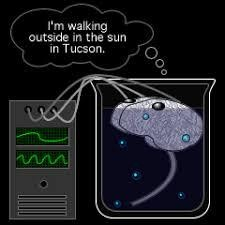
If you have ever gone camping and thought about it, you might realize it's one of the weirdest activities ever. Why would you ever willingly abstain yourself of modern comforts to be in the middle of nowhere, perpetually bored? While I am indifferent to it, I can understand the connection we feel to nature that cannot be replicated. That being said, it's possible that in the future, we could have the same camping atmosphere within Virtual Reality. As David Chalmers puts in his book Reality+ Virtual Worlds and The Problems of Philosophy , “Life in virtual worlds can be as good, in principle, as life outside virtual worlds.” For the nature lovers out there, you could experience the smell of cedar wood, or the sound of rustling leaves without having to leave air conditioning. If Virtual Reality can be just like our reality that begs the question, “Should we move our lives to a virtual world?” An interpretation based off of Chalmers book would be that it is reasonable to choose one or the other since both worlds are essentially the same. My opinion differs in the reasoning that I think there are things about our reality that Virtual Reality just cannot replicate. Past the senses and maybe even the conscious awareness there is something that makes our world idiosyncratic. And I'll show you why you think the same way.
One famous actuality argument that seems to support my claim is Nozick's “Experience Machine”. Briefly, the “Experience Machine” is a philosophical thought experiment that describes a machine that is able to replicate the experience of anything and everything. You are given the option to either live your current life or be hooked up to the machine and experience any life imaginable. The majority of people would choose to not be hooked up to the machine which is indicative of my claim. The “Experience Machine” is conceptually similar to a futuristic version of Virtual Reality yet, most people have a preference for real life over experience. One might suggest that people want to actually do the events they experience. Although Chalmers recognizes this problem for his statement, and one of his rebuttals is that virtual reality is not like the “Experience Machine”. You can build your own life as you choose with the possibility of valuable and meaningful relationships with others. I find this to be a weak rebuttal though, I think you can experience a meaningful life through VR but not actually have one. Until VR becomes so advanced that it is able to change our conscious awareness of itself, anything accomplished inside of VR will be a pretender compared to our natural path of life.
That's why I think today's version of VR is crappy to use for any part of my debate. No person today would choose to live inside an Oculus world. We don’t have the technology to support life for long periods of time and the experience is subpar at best. Instead, Chalmers brought up a great movie alternative for the VR future we don't have yet. Let me introduce Ready Player One; a cinematic masterpiece set in a time where humans have destroyed their own habitat but are saved by the OASIS, a VR world that allows people to escape their self made tragic lives. On the surface this might sound like a great demonstration of a reasonable choice to live in VR. Looking closer, there is a cautionary thesis built in with one of the characters in the movie, James Halliday or the creator of the OASIS, spent his entire life trying to escape reality. His entire life he focused on what could be, instead of what was right in front of him. While this allowed him to be a great innovator of the future, it also caused him to betray his best friend, and never take the leap for the love of his life. Halliday reflected on his life during his dying moments and realized “I was afraid all my life up until the day I knew my life was ending. That's when I realized that, as terrifying and as painful as life can be, it's also the only place where you can get a decent meal.” (Ready Player One) While it is true that life is where the food is at, I think Halliday symbolizes more than a physical complication with VR. The decent meal goes back to what I stated about nature. There are small things about life that collectively make this place better than any other. The cheese burger after a grueling day of work, camping, nothing about these things can’t be replicated by VR. Yet, these are the things that I cannot imagine Virtual Reality ever comparing to. These events are so correlated with the idea of life that life has less meaning without them. Halliday teaches us that only a fool would focus so much of their time creating a new world instead of appreciating the small details of the one we are already a part of.
It's scary to think that we will have the power in the future to decide whether or not to live in a true virtual world. Even right now people are living part of their lives in downgraded VR experiences like videogames or in the near future, socializing over call or facetime. As Ready Player One showed I am a firm believer that we need time away from virtuality and at the end of the day, “reality is the only thing that's real”. (RPO)
Image Source
Headline Image
