
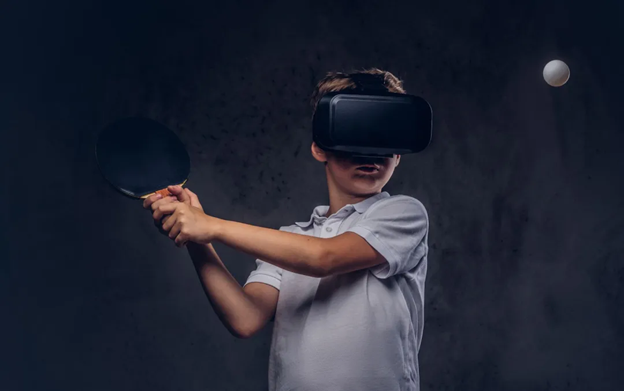
As humans, when we experience uncertainty or stressful situations, we often turn to the internet or physical activity to quell that fear. Whether it's playing a game with friends or doomscrolling the internet and drowning our sadness in instagram reels, we seek to find an escape from our current situation. Not because they fix anything but rather provide us with the relief our brains are hunting for. These moments are characterized by engagement rather than resolutions; they allow us to momentarily disconnect from the world and escape to our comfort zone.
For many sports it provides just that, the joy of playing an organized sport or even just channeling that stress into training are all sources we seek out. As the world moves into a digital world, so did sports, from NBA2K to FIFA, these digital sports allowed us to enjoy sports digitally. With virtual reality being the newest hit, it's only a matter of time before full fledged sports games are developed but will it fully recreate the outlet for distress? While virtual reality promises immersion and interactivity like the real world, sports are beyond the plane that virtual reality encompasses. Sports can be simulated visually, but not fully embodied because of the bodily demand and human interactions that define what it's like to play sports. Beyond the physical space, sports are fundamentally social. Competing against real opponents introduces uncertainty and emotional pressure that define sports. These limitations result in an inadequate substitute for the physical and emotional relief real world sports provide meaning virtual reality cannot replicate the same stress relieving impact that comes from genuine bodily exertion and human interaction.
The growing sophistication of virtual reality has allowed developers to simulate real world environments in a virtual world. The developments aren’t just making the graphics look more realistic but rather adding the laws of physics into the code base. This naturally tricks out brains to believe that something is functioning the way it's supposed to. If I drop a ball or throw it, the path it follows should simulate what it would look like in the real world if virtual reality is attempting to become fully immersive. But what about other aspects of physics? How is virtual reality going to recreate the feeling of me getting tackled in football or falling after a dunk. Well it can't, virtual reality can trick the eyes but the other senses are much more complicated. The experience is not just slightly altered, it is physically different. In real sports, the body absorbs force and reacts on feel in real time. In virtual environments, those forces are simulated visually but not physically enacted on the body. Human perception relies heavily on proprioception and kinesthetic feedback- the bodies awareness of space, balance and impact- which virtual environments fail to recreate. Without the physical forces of nature acting on the body, virtual reality feels unrealistic and lacking.
When I had the pleasure of stepping into virtual reality myself, I was excited to know that laws of physics were already incorporated into games such as first steps, and they had ping pong as a way to introduce the user to the possibility of sports in virtual reality. But something always felt off when I was swinging the paddle, it wasn't that the ball was going in a weird direction and not obeying the laws of physics, but rather the vibration I get in my hand when I do hit the ball. When I play racket sports like ping pong or badminton in real life, the feeling of making contact with the ball is indistinguishable. In virtual reality, that feedback is reduced to controller vibrations, a simplified substitute for a far more complex sensory experience.
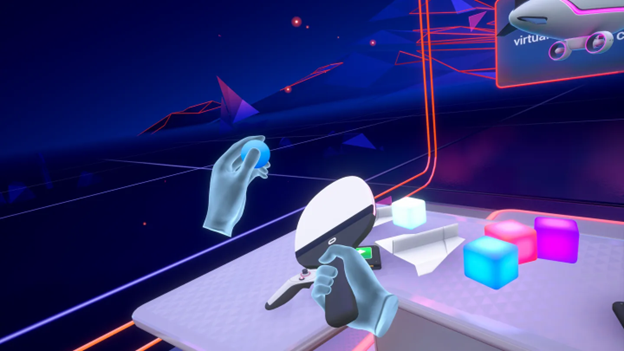
Yes, I was able to still hit the ball, but my brain still made a distinction between what I was experiencing with what I was used to. In addition, in a sport where movement and feel is key, the virtual version lacked that, it felt no different then playing a sports game online, where you stood in place and only moved your hand.
Researches such as Slater and Sanches-Vives encompass this in their research paper Enhancing our lives with immersive virtual reality by stating “it would be important to carry out rigorous studies to check in case small differences between the VR version and the real version might lead to poor skills transfer, or incorrect learning”, there are aspects of sports that the virtual world just can't recreate. Throughout a subsection of their report on virtual reality, they repeatedly emphasize how virtual reality will fall short of physical aspects in sports such as muscle activation and movements like tackling in football. These contact instances complicate how accurately VR can be with sports as they don't present the same danger sense that real contact does. Injury in contact sports is something that's just unavoidable in certain circumstances: even in non contact sports, rolling your ankle over a poor decision is a very real possibility, a possibility that only exists in the real world. Due to ethical reasons no game should ever be able to physically harm its user, I shouldn't get a dislocated shoulder in real life over a tackle in Madden nor should I get one in any virtual reality. But without aspects like these there will never fully feel immersive.
Virtual reality can trick the eyes but it can never truly trick the body. Sports will still be integrated into virtual reality at some point, it will still serve as an escape from reality and a chance for us to destress and reorganize. The way in which it is done will never feel the same as when you do in the real world. Humans are creatures of action, we evolved on muscle feedback and interaction with our environment through our senses, strip that away and we don't feel like ourselves, we don’t feel human.
Image Sources
Headline Image
Image 1
