

The internet has fundamentally trained us to consume emotions rather than experience them; the process of scrolling through eye-catching short form content, polarizing political statements, and heartbreaking penguin videos has forced users to switch feelings with each swipe, building an emotional callus through constant, detached unprocessed emotions. As the numbness deepens, many have turned to virtual reality (VR) as a more immersive solution, believing that its quickly advancing technology will be able to deliver the authentic emotional experiences that we crave.
According to Slater and Sanchez-Vivez, “VR is a powerful tool for the achievement of authentic experience – even if what is depicted might be wholly imaginary and fantastic.” Designed to induce human emotions and mimic physical situations, AI is now being called an “empathy machine,” marketed to be able to produce real emotions in its users.
However, while virtual reality has the ability to produce neurologically authentic responses by releasing hormones like adrenaline and endorphins, it's undermined by the absence of material stakes. This gap shows that authentic human emotion requires not just the “right” neurological triggers, but also meaningful outcomes and the sustained belief in its form as a genuine reality.
VR’s immersive games, such as Richie’s Plank Experience, help to demonstrate how easily the brain can be hijacked into thinking it’s in a genuine state of panic—but also how quickly that fear disappears when the illusion is broken. The psychological game simulates walking a wooden plank 80 stories high, designed to induce physical manifestations of trepidation with realistic sensory details.
At the University of Rochester’s Studio X, I was able to try the Meta Quest 3 headset, and the desired goal of the Richie’s Plank Experience gamemakers initially succeeded. As I pressed the elevator button with haptic feedback and ascended, my heart began to race and sweat perspirated on the palms of my hands, the same response to real-world stress. My feet, as if stepping onto pins and needles, began to have a numbing sensation caused by the anxiety-induced adrenaline rush. My body had responded as if the danger was real—which makes sense because neurologically, it was processing actual visual threat signals.
But as I stepped forward on the creaking wooden plank, glancing at my nonexistent virtual feet, my field of vision slowly began to reveal the physical world. I had left the guardian boundary set by the VR headset and could clearly see the white library walls and other students wobbling through their own imagined realities. The moment I stepped backward to reenter the virtual world, the fear vanished entirely and the facade broke—I was distinctly aware that everything I was seeing was fake.
I jumped off the plank without hesitation or worry. The same brain signals that had just been flooded with fight-or-flight hormones now registered nothing almost instantaneously, a numbing feeling that was all too familiar with internet “doom scrolling.” With the stark acknowledgement of the physical world, consequences didn’t exist despite the identical visual and auditory stimulus. The virtual reality barrier had been broken. But what if it hadn’t been? Would the VR experience be able to then create actual emotional meaning?
Unfortunately, similarly, the Trolley Problem VR Simulation also failed to induce accurate physical world emotions. The ethical dilemma to save five workers by redirecting a train to kill one, or do nothing and let five die, should provoke genuine moral distress. And while I did feel bad for the workers, the sheer lack of facial expressions on the figures, the unrealistic train switch mechanics, and the constant interruption of survey questions all revealed to me that this was purely a fake simulation for data collection, not a crisis. The VR simulation was clearly more concerned with gathering research, as demonstrated by the nearly 30 questions it asked about my demographics, rather than invoking worry or sadness, undermining the entire premise of testing authentic emotional and moral responses. Such a virtual experience would never truly be like if you were actually standing in front of a lever and witnessing a trolley hurriedly race toward real people.
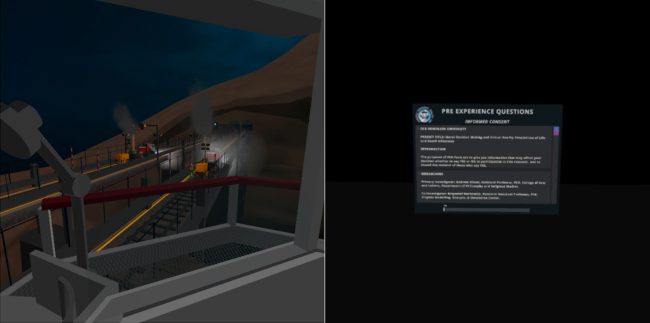
Yet, researchers Slater and Sanchez-Vives argue that VR has the capacity to produce meaningful emotions. Their similarly structured trolley problem study found that subjects in VR who had to actively pull the switch to save five people showed greater physiological response than those that could save five by doing nothing. Through their unexpected findings, like how users had a “greater tendency to sacrifice males,” researchers were able to access more authentic human responses than merely hypothetical questioning, making VR valuable for ethics research that would otherwise be impossible or unethical to conduct.
Their research appears to contradict the claim that VR emotions are hollow vessels of technology. Afterall, if VR can produce genuine physiological responses and test human behaviors, wouldn’t that prove that it creates authentic emotional experiences? The heart of the issue lies in distinguishing between emotional response and emotional meaning. Slater and Sanchez-Vivez’s experiment proved that VR can trigger the neurological mechanisms of emotion, but what they didn’t prove is that these responses carry the same psychological weight as physically real experiences. The user can’t be traumatized by Richie’s Plank knowing that it wasn’t real, and they can’t be altered by personal decisions that frankly changed nothing like in the Trolley Problem. The emotions are real in the moment, but they immediately disappear once they’re untethered from the virtual world.
This gap is precisely what makes VR problematic as an “empathy machine.” For users that try to find authentic empathy development, the absence of real consequences is what prevents it from delivering life-transforming emotional experiences that it promises. Until VR can create experiences where emotions persist beyond the quick moment it's presented, where choices carry weight and consequences matter, it’ll continue to act as merely a tool for studying emotion rather than authentically experiencing it.
Image Sources
Headline Image
Image 1
